27 October 2026 4 min read
A vaccine made from each patient's tumour cut melanoma's return, trial finds
In 1,137 people whose melanoma was removed, a vaccine built from their own tumour cut the cancer's return by 42 percent. It is not peer reviewed or approved.
On this page
The short version
- What was studied: 1,137 people whose skin cancer, melanoma, had been removed by surgery. All got a standard cancer drug, and chance decided who also got a vaccine built from their own tumour [1][2].
- What it found: after 2 years, about 82 in 100 people on the vaccine were still free of cancer, against 70 in 100 without it. That is a 42 percent lower risk of the cancer coming back or death [1].
- What it does not show: that people live longer, which is not clear yet, or that it is available. The results were shown at a meeting, the full paper is not out, and it is not approved anywhere [1][2].
What if a cancer vaccine could be made for one person only? In a large trial of a personalised mRNA melanoma vaccine, each person got a vaccine built from their own tumour, on top of a standard cancer drug. After 2 years, 82 in 100 were still cancer free, against 70 in 100 without the vaccine [1].
Put another way, the vaccine group had a 42 percent lower risk of the cancer coming back, or of death, over the time studied [1].
Here is the main caveat, said plainly. These results were shown at a cancer meeting and the full paper is not out yet, so other scientists have not checked them. The vaccine is not approved anywhere, and it is not yet clear whether people live longer [1][2].
The trial is called INTerpath-001. Its lead researcher is Georgina Long of Melanoma Institute Australia and the University of Sydney. The results were shown at the ESMO Congress 2026, a large European cancer meeting, as abstract LBA1. A short summary like this is called an abstract. The numbers here come from that abstract as it was reported, and the full paper is said to be on its way to a medical journal [1].
How does a vaccine made from a tumour work?
Melanoma is a skin cancer that starts in the cells that give skin its colour. Surgery can remove it, but in people at high risk it often comes back. The people in this trial had melanoma at stage IIB to IV, which means it was thick, had reached nearby glands, or had spread further [1].
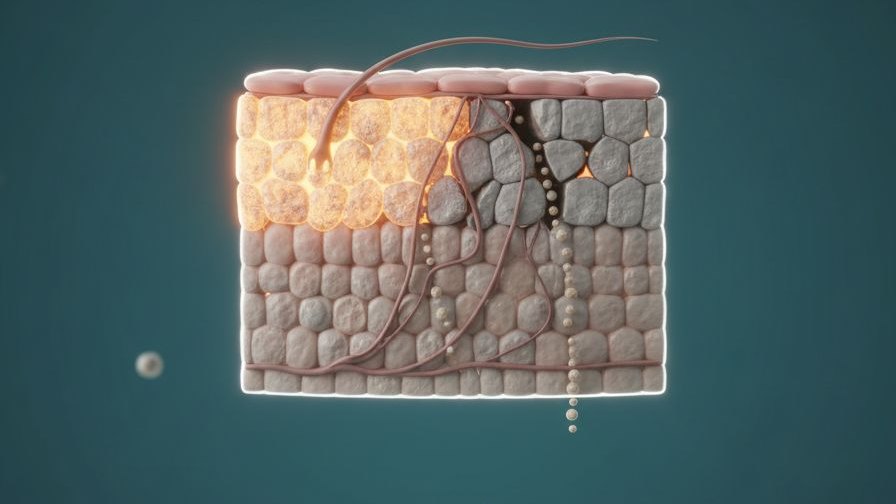
To make each vaccine, a piece of the removed tumour is read for changes in its genes. Some changes make markers found only on that person's cancer cells. The vaccine is built from mRNA, a short set of written instructions that cells read to make a protein. Here, the instructions tell the body to make those cancer markers, so the immune system learns to spot them [1][3].
The standard drug in both groups was pembrolizumab. It works by taking a brake off the immune system. In an earlier trial in people whose melanoma had been removed, it already lowered the chance of the cancer coming back, compared with a fake drug [4].
What did the trial find?
The trial took 1,137 people. Chance decided, like a coin flip, who got the vaccine with the standard drug and who got a fake vaccine with the standard drug. Two people got the vaccine for every one who did not. Neither the patients nor their doctors knew who had which [1][2].
People were followed for about two years on average. By then, 82.2 in 100 on the vaccine had no sign of cancer coming back, against 70.0 in 100 on the standard drug alone. The vaccine group was also less likely to see the cancer spread to distant parts of the body: about 89 in 100 were free of that, against 80 in 100 [1].
Serious side effects linked to treatment were about as common in both groups. They hit about 14 in 100 people with the vaccine and 13 in 100 without it [1]. Data on how long people live are not ready yet, which means nobody can say whether the vaccine helps people live longer [1].
Who ran the trial, and what do earlier trials show?
The trial was run and paid for by its makers. Its sponsor is the drug company Merck Sharp and Dohme, working with Moderna, the company behind the mRNA part [2]. The main result, whether the cancer came back, was judged by the trial's own doctors rather than an outside panel, according to the trial's registry entry [2].
That registry entry adds two more things. It planned for about 1,089 people, while the meeting reported 1,137. And it lists the main result as due in 2029. The trial keeps going, partly to measure how long people live [1][2].
An earlier trial of the same vaccine was smaller, with 157 people, and everyone knew which treatment they got. After 18 months, 79 in 100 on the vaccine were cancer free, against 62 in 100 on the standard drug alone. That gap was promising but not clear enough to rule out chance. Moderna paid for that trial, working with Merck [3]. Its authors wrote:
These results provide evidence that an mRNA-based individualised neoantigen therapy might be beneficial in the adjuvant setting.
Weber and colleagues, The Lancet, 2024 [3]
In plain words, the first trial hinted that the vaccine might help people after surgery. Adjuvant just means a treatment given after surgery to stop a cancer coming back. The new, much larger trial was built to test that hint, and its early numbers point the same way [1][3].
This work does not show that the vaccine helps people live longer, and it does not show how it works in other cancers. It has not yet been checked by other scientists in a full paper. What it does show is narrower. In a large fair test, adding a vaccine made from each person's own tumour made melanoma less likely to come back after surgery [1][2][3].
What it does not show
that people live longer, which is not clear yet, or that it is available. The results were shown at a meeting, the full paper is not out, and it is not approved anywhere [1][2].
Sources
- INTerpath-001: intismeran autogene plus pembrolizumab vs placebo plus pembrolizumab in resected high-risk melanoma (Long et al., abstract LBA1)ESMO Congress 2026, 2026
- INTerpath-001 trial registry record, NCT05933577ClinicalTrials.gov, 2025
- Individualised neoantigen therapy mRNA-4157 (V940) plus pembrolizumab versus pembrolizumab monotherapy in resected melanoma (KEYNOTE-942): a randomised, phase 2b studyThe Lancet, 2024
- Adjuvant Pembrolizumab versus Placebo in Resected Stage III MelanomaNew England Journal of Medicine, 2018
How we wrote this: numbers are given just as the scientists reported them. See Our rules for writing and How we fix mistakes.